 Skip to content

WordPress, the world’s most widely used content management system (CMS), is experiencing a noticeable decline in market share, according to the latest data released by W3Techs. While the platform still powers more websites than any competitor, recent statistics suggest that its dominance is gradually weakening as alternative website-building platforms continue to attract new users.
WordPress Market Share Continues to Slide
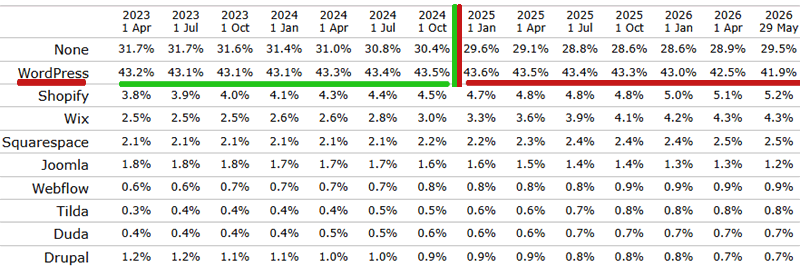
For years, WordPress maintained a relatively stable market share of around 43%. However, recent figures indicate a steady downward trend.
According to W3Techs data:
- December 2025: 43.2%
- January 2026: 43.0%
- February 2026: 42.8%
- March 2026: 42.7%
- April 2026: 42.5%
- May 2026: 41.9%
The platform has lost approximately 1.3 percentage points in just six months, a significantly faster decline than seen throughout 2025.
Also Read: WordPress 7.0 Officially Released With AI Features, Smarter Navigation, and Visual Revisions
Competitors Are Gaining Ground
While WordPress is losing market share, several competing platforms are showing positive growth.
Platforms Recording Growth
- Wix: +0.6%
- Shopify: +0.4%
- Squarespace: +0.2%
- Webflow: +0.1%
Stable Platforms
- Duda: No significant change
Declining Platforms
- WordPress: -1.6%
- Joomla: -0.3%
Industry observers note that competing website builders have become more user-friendly, feature-rich, and performance-oriented, making them attractive alternatives for businesses and creators.
Why Is WordPress Losing Ground?
Several factors may be contributing to WordPress’s slowing growth:
Increased Competition
Modern website builders such as Wix, Shopify, and Webflow have improved dramatically over the past few years. These platforms offer simpler setup processes, built-in hosting, and integrated design tools.
User Experience Challenges
Many users continue to criticize WordPress for:
- Complex maintenance requirements
- Plugin compatibility issues
- Security concerns
- Learning curve for beginners
Performance Concerns
Recent industry reports suggest that some competing platforms now outperform WordPress in Core Web Vitals and overall website performance metrics.
Community and Industry Controversies
Industry analysts have also pointed to public disputes within the WordPress ecosystem as a possible factor affecting adoption and perception among developers and businesses.
Emerging Frameworks Are Growing Rapidly
One of the biggest success stories in the web development space is Astro, a modern website framework experiencing explosive growth.
Astro downloads reportedly increased from:
- 4.59 million in January 2026
- 5.36 million in February
- 7.72 million in March
- 9.24 million in April
This rapid growth highlights the increasing demand for modern web development solutions focused on speed and performance.
Also Read: Big Changes From August 1: UPI, Credit Cards & Digital Payments Rules to Impact Millions
Can WordPress Recover?
Despite the recent decline, experts believe WordPress remains a dominant force in the web ecosystem.
The platform benefits from:
- A massive global community
- Thousands of plugins and themes
- Extensive developer support
- Strong enterprise adoption
Recent updates focused on artificial intelligence and workflow improvements could help WordPress regain momentum in the coming months.
Conclusion
Although WordPress continues to lead the CMS market, recent statistics indicate that competitors are steadily gaining ground. Whether this trend continues or reverses will depend on how effectively WordPress adapts to changing user expectations, emerging technologies, and increasing competition from modern website-building platforms.
For now, the battle for website market share appears more competitive than ever.
Read in App ★ Free